Water Quality

Water remains safe to drink. Some residents may notice an earthy or musty odour caused by naturally occurring compounds. 

Updated Sept 4, 2026

Drinking water remains safe

Since the weekend of August 16, the City has received reports from residents of a slight earthy or musty odour when running cold water from their taps. The City’s Water Treatment Plant has collected water samples for further testing. Based on the results to date, the City can confirm that the water remains safe to drink.

Additional sampling and testing are underway to better understand the conditions affecting the water system.

How Long Will the Taste and Odour Last?

The duration of the issue will depend largely on source water conditions. Typically, these concerns begin to improve as:

  • Cooler temperatures return.
  • Natural organic compound levels in the North Saskatchewan River decrease.

Water Testing

Geosmin and MIB Testing

The City conducted targeted testing for the compounds most commonly associated with earthy and musty tastes and odours in drinking water: geosmin and 2-methylisoborneol (MIB).


Laboratory results received on August 28, 2026, from samples collected on August 19, 2026, showed:


Parameter Raw Water Treated Water
Geosmin 57 ng/L 34 ng/L
MIB Below 3 ng/L Below 3 ng/L


Please note that these samples were collected on August 19 and sent to Toronto for testing, so they may not accurately reflect current levels. 

The human nose is extremely sensitive to these naturally occurring compounds. If you poured a teaspoon of the compound into the equivalent of 200 Olympic-sized swimming pools, you would still be able to smell it.  The general threshold for human detection is about 15 ng/l (15 nanograms per litre = 15 parts per trillion). However, some people can detect these compounds in drinking water at concentrations as low as 5 ng/l.  

This is why one person may complain that the tap water smells earthy while another person standing beside them notices nothing at all.

Heating the water increases the volatility of these compounds, which is why the smell is more easily detected in the shower or when used for hot beverages. 

Weekly Distribution Sampling Program

The city is divided into nine weekly testing quadrants to monitor distribution health, scheduled as follows. 

See results at this link

  • Monday (3): Safeway, Wastewater Plant, Lift Station (by the Old Coca-Cola bottling plant).
  • Tuesday (3): Airport, Holiday Inn (Yard District), Marquis Inn.
  • Wednesday (3): Coronet Inn, Alfred Jenkins Field House, Victoria Hospital.

Targeted distribution system results

On August 24, 2026, we received the results of samples tested at Water Treatment Plant, Steuart Ave, Johnson Cres and Marquis Reservoir:

The Johnson Crescent sample exhibited severe discolouration. The Steuart Avenue sample was less severe but still clearly abnormal. No total coliform was detected in any sample. Coliform refers to a group of bacteria commonly used as an indicator of water quality.

How do current organic matter levels compare to historical averages?

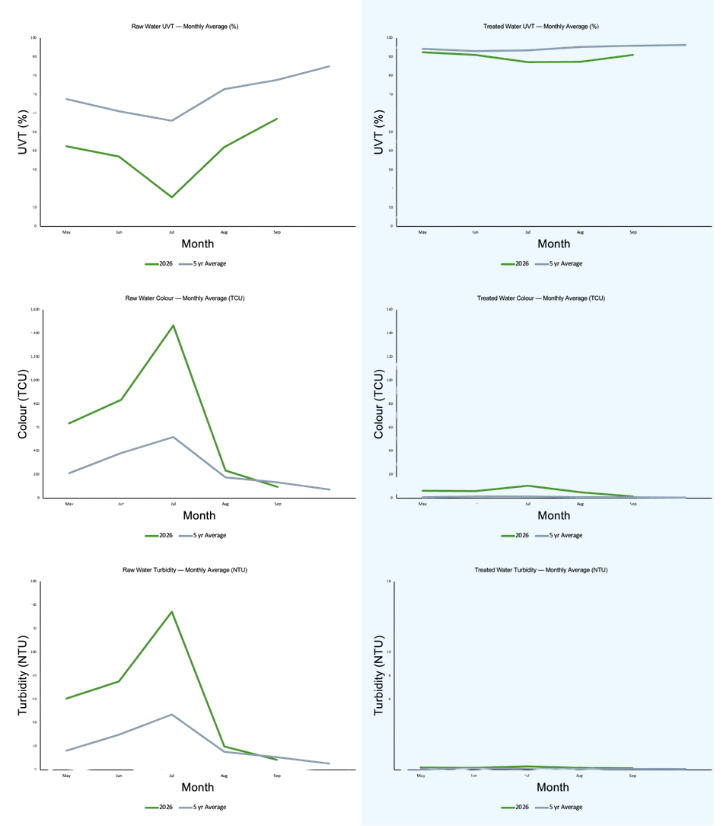
As shown below, our 5-year water quality data indicate that 2026 saw unusually high levels of naturally occurring organic matter, colour, and turbidity in the North Saskatchewan River.

While these conditions have created challenges, the Water Treatment Plant has continued to effectively improve water quality before it reaches homes and businesses.

Recent monitoring results also suggest source-water conditions may be starting to improve. Extensive testing continues to confirm that Prince Albert's drinking water remains safe.

* TCU and NTU are units used to measure different aspects of water quality:

NTU = Nephelometric Turbidity Units: Measures how cloudy or murky water is because of suspended particles such as sediment, clay, organic material and other particles.
TCU = True Colour Units: Measures the colour of the water, particularly colour caused by dissolved substances such as naturally occurring organic matter from vegetation, soil and runoff.
UVT =(Ultraviolet Transmittance) is the percentage of UV light passing through a water sample and is an important indicator of water quality and the effectiveness of UV disinfection.

Why have the taste, odour, and discolouration issues persisted for nearly two months?

While it may seem like one ongoing problem, the City has actually been dealing with three separate water-related issues that occurred around the same time: 

  • Tea-coloured water (June): Caused by unusually high levels of naturally occurring organic matter in the North Saskatchewan River following runoff and higher river flows. This affected the appearance of the water.

  • Earthy or musty taste and odour (mid-August): Caused by geosmin, a naturally occurring compound produced by algae and microorganisms in rivers and lakes. Geosmin affects taste and smell but does not affect water colour. 

  • Localized discolouration during flushing: As crews investigated the taste and odour concerns, hydraulic flushing was conducted throughout the distribution system. This work can temporarily disturb sediment and rust inside water mains, causing isolated discolouration in some neighbourhoods. 

Although these issues occurred within a relatively short period, they had different causes and required different responses. The discolouration, taste and odour concerns were all linked to natural river conditions or distribution system maintenance activities, but they were not the same problem.

Ongoing oversight

The Water Treatment Plant operations are currently optimizing chemical dosing (e.g., carbon (PAC) and potassium permanganate) to compensate for naturally occurring organic matter in the raw water. PAC is commonly used throughout the water industry to remove naturally occurring compounds that can contribute to taste and odour concerns.

The City will continue working with provincial regulators and other water-treatment facilities to monitor these conditions and ensure the ongoing safety of our drinking water. The City will continue to collect and analyze samples, monitor water-quality conditions, and provide updates as additional results become available.

The Water Security Agency and SaskHealth have visited the City’s Water Treatment Plant to gain a better understanding of the extent of the concerns and discuss the City’s approach to addressing the aesthetic factors around discoloration.

Geosmin Treatment Challenges:

Geosmin is particularly challenging because it can be detected at extremely low concentrations (5 parts per trillion) and is primarily dissolved in water. Conventional coagulation, clarification and filtration processes are not designed to remove it completely. 

 Even with optimized powdered activated carbon treatment, complete removal may not always be achievable during periods of elevated source-water concentrations. This challenge is not unique to Prince Albert or to our treatment system. Seasonal taste-and-odour compounds can affect many treatment facilities that rely on surface-water sources. 

Is aging water infrastructure contributing to the problem?

While some older water mains can contribute to localized discolouration, metallic tastes, or minor odours, the widespread nature of the discolouration experienced this year suggests source water conditions are the primary factor.  

Unlined cast iron water mains, some more than 100 years old, make up 24% of the 213.7km of pipes in Prince Albert. These mains can develop internal corrosion and rust buildup (tuberculation), which may be disturbed during periods of low water use or sudden changes in flow, releasing sediment into the water and causing red, brown, or yellow discolouration.  

However, because the current discolouration has been observed across multiple areas of the city rather than in isolated locations, it is difficult to attribute it to specific sections of aging water main.  

As recommended by the Water Security Agency, the City is undertaking hydraulic flushing, beginning in Ward 1, to help remove accumulated sediment from the distribution system and maintain water quality. 

When would a Drinking Water Advisory be issued?

Drinking Water Advisories are not issued solely on the basis of aesthetic concerns such as taste, odour, or colour.

An advisory would be considered if water quality monitoring indicated a potential risk to public health, including microbiological contamination, inadequate disinfection, treatment failures, or any parameter exceeding health-based regulatory standards.

As long as testing confirms the water continues to meet all provincial and federal drinking water health requirements, taste, odour, and appearance issues alone would not typically warrant a Drinking Water Advisory.


From River to Tap: How Prince Albert Treats Your Drinking Water


Water discolouration is caused by the movement of naturally occurring minerals that can build up on the inner walls of water pipes. Changes in water pressure or flow can loosen these minerals and temporarily affect the colour of the water.

Activities that may cause coloured water include:

  • Water main breaks
  • Work on water pipes, including hydraulic flushing, repairs or replacements
  • Hydrant inspections


Some residents may occasionally notice an earthy or musty taste or odour in their drinking water. This can be caused by naturally occurring organic matter, a compound produced by certain algae and soil bacteria, which is found in surface water.

Naturally occurring organic matter can affect the taste and smell of water, but it is not harmful and does not affect the safety of drinking water. Ongoing testing confirms that there are no harmful bacteria or other pathogens in the water.

Naturally occurring organic matter is a naturally occurring compound that communities across Canada and around the world may experience, particularly during warm weather in late summer and early fall.

Quick Answers

Is my water safe to drink?
Yes. Naturally occurring organic matter affects the taste and smell of water, not its safety. Routine testing confirms the water remains safe to drink.

What causes the earthy or musty taste and odour?
Naturally occurring organic matter can be produced by algae and bacteria in surface water such as rivers, lakes and streams. It is not an indication of pollution or a failure of the water treatment process.

When does it occur?
Naturally occurring organic matter events are infrequent and are most common in late summer and early fall, when warmer water can promote algal growth.

Why can I smell it so easily?
The human nose is very sensitive to naturally occurring organic matter, and even very small amounts can be detected. Heating water can make the odour more noticeable, which is why it may be more apparent during showers or when making hot drinks.

How can I reduce the taste or odour at home?

We understand this can be frustrating, particularly when the odour is strong enough to affect drinking water, cooking or other household uses. The City continues to investigate elevated levels of natural compounds and to monitor water quality throughout the treatment and distribution system.

While the City continues to monitor and investigate the elevated geosmin levels, residents who are experiencing the taste or odour may find the following helpful:

  • Chill the water: Refrigerating water can make the taste and odour less noticeable.
  • Use a drinking-water carbon filter: An activated carbon filter designed for drinking water may help reduce compounds that affect taste and odour. Follow the manufacturer's instructions and replace the filter as recommended.
  • Let the water stand: Placing water in a covered container in the refrigerator for several hours may help reduce the noticeable odour.
  • Use bottled water if preferred: Residents who find the taste or odour particularly unpleasant may choose to use bottled water for drinking and cooking until the odour becomes less noticeable.

These steps are intended to help with taste and odour only. They do not replace the City's ongoing monitoring and testing of the water system.

Why do these events occur?

Naturally occurring organic matter events are influenced by natural changes in source-water conditions, including temperature, pH and organic matter. Warm temperatures can promote the growth of algae and other microorganisms that produce naturally occurring organic matter.

The timing of naturally occurring organic matter events cannot be predicted precisely. Typically, the taste and odour subside as source-water conditions change and temperatures cool.

The following information required pursuant to section 22.5 of the Cities Regulations is available for inspection at City Hall during regular office hours:

  • Waterworks rate policy and capital investment strategy
  • Waterworks financial overview 
  • Current reserves
  • Most recent waterworks independent engineering assessment
  • Capital plans for waterworks infrastructure projects and sources of funding

Please contact Financial Services at 306-953-4350 if you would like to view this information; it is also available online in the Annual Report.

What should I do if my water is discoloured?

  • Run the cold water tap for approximately 10 to 15 minutes, or until the water runs clear.
  • If discolouration is only present in hot water: Run the cold water for a few minutes. If the cold water is clear but the hot water remains discoloured, the issue may be related to your hot-water tank or plumbing. Contact a qualified plumber or your building/property manager for further assessment.

  • If the water does not clear after running the cold water, contact the City. Use the keyword Water Condition


Contact Us

City of Prince Albert
1084 Central Avenue
Prince Albert, SK S6V 7P3
Phone: 306-953-4884
After Hours Emergency: 306-953-4348
Email Us