Drinking water remains safe
Since the weekend of August 16, the City has received reports from residents of a slight earthy or musty odour when running cold water from their taps. The City’s Water Treatment Plant has collected water samples for further testing. Based on the results to date, the City can confirm that the water remains safe to drink.
Additional sampling and testing are underway to better understand the conditions affecting the water system.
Water testing results
Samples were collected from where residents reported significant discolouration. All samples returned negative bacteriological results. Complete analytical reports, including additional testing, are expected by the end of this week.
Additional samples have also been collected from the City’s reservoirs and submitted for further analysis. Nine distribution locations throughout the city are tested weekly: See results at this link
Samples have also been submitted for geosmin and MIB analysis. These naturally occurring compounds can contribute to earthy or musty tastes and odours in drinking water. These results will take approximately 2 weeks.
Daily average UVA254 decreased from 0.0650 cm⁻¹ on August 17 to 0.0506 cm⁻¹ on August 24, a reduction of approximately 22%. This steady downward trend indicates that levels of UV-absorbing organic matter in the treated water continue to decrease, and that water quality is improving.
A reduction in chlorine demand has been observed at reservoirs and sampling locations across the City, indicating an overall decrease in organic matter entering the distribution system from the river and in its retention within it.
Treated water can take up to three to four days to move through the distribution system. Therefore, residents may not notice improvements in water quality on the same day that improvements are observed at the Water Treatment Plant.

Discolouration and odour are separate issues
Based on the information currently available, the City can confirm that the reported discolouration and odour are separate issues.
The reported odour is consistent with elevated levels of naturally occurring organic matter and seasonal biological activity in the river. Similar conditions are currently being experienced at other upstream water-treatment facilities, including those serving Lloydminster and North Battleford, where elevated levels of naturally occurring organic matter have also been observed.
The City’s assessment is supported by organic sampling results, increased chlorine demand and other water-quality parameters routinely monitored by Water Treatment Plant operators.
Why does the water smell?
The human nose is extremely sensitive to these naturally occurring compounds. If you poured a teaspoon of the compound into the equivalent of 200 Olympic-sized swimming pools, you would still be able to smell it. The general threshold for human detection is about 15 ng/l (15 nanograms per litre = 15 parts per trillion). However, some people can detect these compounds in drinking water at concentrations as low as 5 ng/l.
This is why one person may complain that the tap water smells earthy while another person standing beside them notices nothing at all.
Heating the water increases the volatility of these compounds, which is why the smell is more easily detected in the shower or when used for hot beverages.
Ongoing oversight
The Water Treatment Plant operations are currently optimizing chemical dosing (e.g., carbon (PAC) and potassium permanganate) to compensate for naturally occurring organic matter in the raw water. PAC is commonly used throughout the water industry to remove naturally occurring compounds that can contribute to taste and odour concerns.
The City will continue working with provincial regulators and other water-treatment facilities to monitor these conditions and ensure the ongoing safety of our drinking water. The City will continue to collect and analyze samples, monitor water-quality conditions, and provide updates as additional results become available.
The Water Security Agency and SaskHealth have visited the City’s Water Treatment Plant to gain a better understanding of the extent of the concerns and discuss the City’s approach to addressing the aesthetic factors around discoloration.
North Saskatchewan River quality
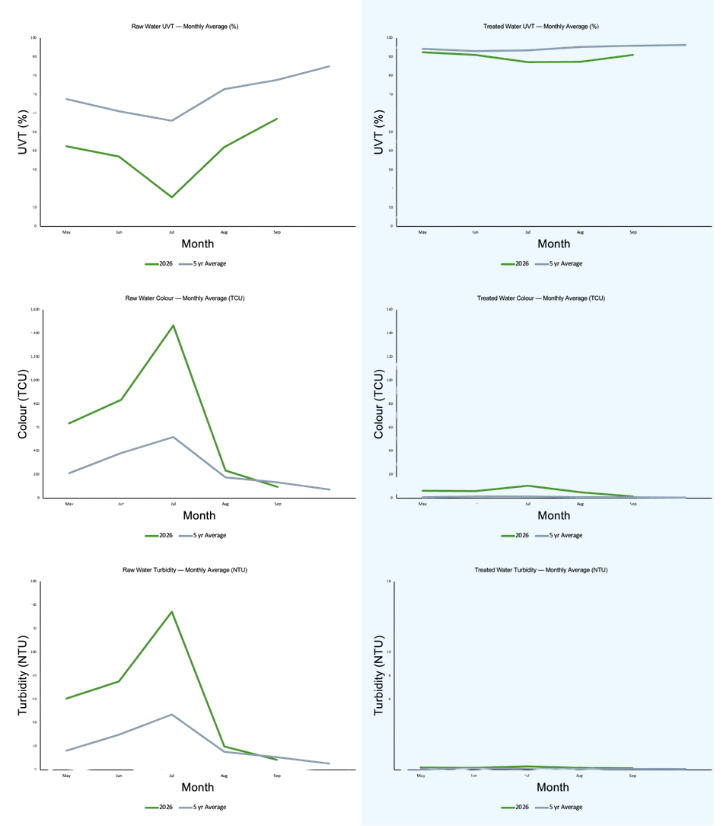
According to the graph below, the North Saskatchewan River has experienced significantly higher-than-normal levels of turbidity and colour since spring, reflecting more challenging raw-water conditions entering the water treatment plant.
| Measurement |
Normal |
July 2026 |
August 1-16 |
| Raw-water turbidity |
20.8 NTU
|
134.3 NTU
|
32.8 NTU
|
| Raw-water colour |
250 TCU
|
1,467 TCU
|
359 TCU
|
|
Raw-water UV transmission
|
71.1%
|
15.5%
|
35.0%
|
|
Treated-water turbidity
|
0.100 NTU
|
0.303 NTU
|
0.185 NTU
|
|
Treated-water colour
|
0.84 TCU
|
10.4 TCU
|
5.8 TCU
|
|
Treated-water UV transmission
|
94.6%
|
87.2%
|
86.5%
|
TCU and NTU are units used to measure different aspects of water quality:
- NTU = Nephelometric Turbidity Units
Measures how cloudy or murky water is because of suspended particles such as sediment, clay, organic material and other particles.
- TCU = True Colour Units
Measures the colour of the water, particularly colour caused by dissolved substances such as naturally occurring organic matter from vegetation, soil and runoff.
In July, raw-water turbidity averaged 134.3 NTU, compared with a normal level of 20.8 NTU, while raw-water colour reached 1,467 TCU, compared with a normal 250 TCU. Conditions improved in August, but remained elevated, with turbidity at 32.8 NTU and colour at 359 TCU from August 1–16. Raw-water UV transmission, which indicates how much light passes through the water, was also substantially lower than normal, at 15.5% in July and 35.0% in August, compared with a normal 71.1%. These measurements demonstrate the unusually variable and challenging conditions in the river this summer, particularly the high levels of naturally occurring organic matter and suspended material in the source water.
From River to Tap: How Prince Albert Treats Your Drinking Water